California license plates in 2026 include the regular standard plate, personalized Environmental plates, special-interest designs, the black-and-yellow California 1960s Legacy plate, qualification-based special plates, Disabled Person and Disabled Veteran plates, and Year of Manufacture plates for eligible older vehicles.
The right option depends on your vehicle, whether you want a DMV-assigned or personalized configuration, the plate program you qualify for, and the extra plate fees you are willing to pay.
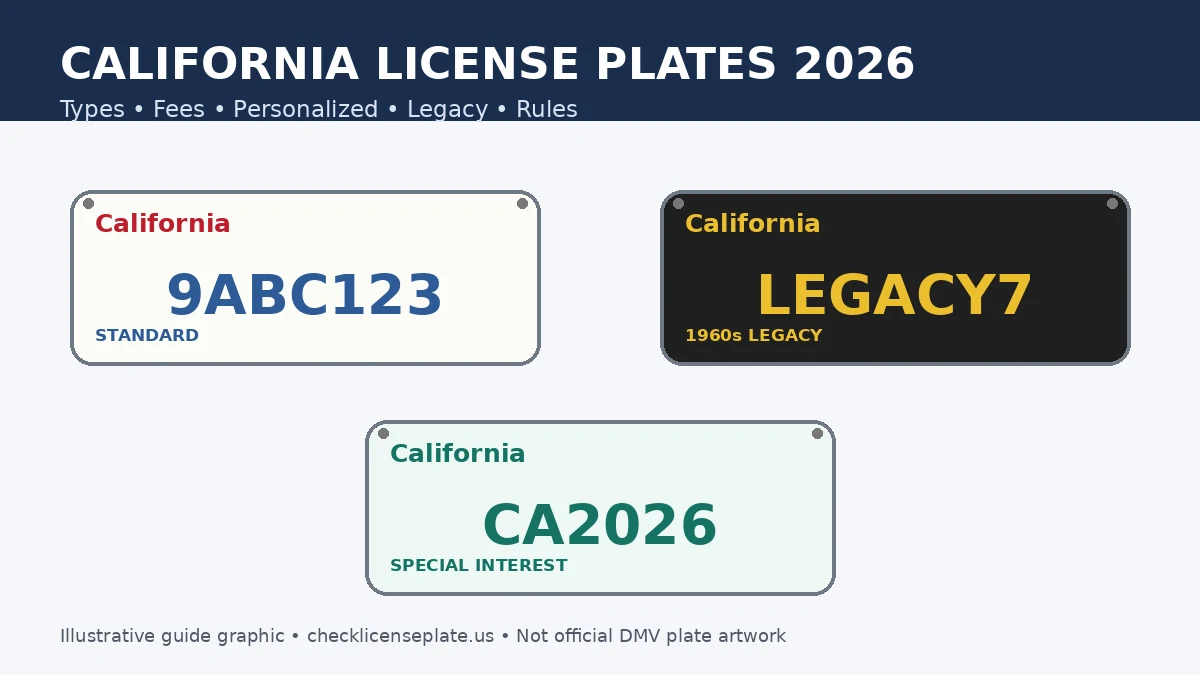
What types of California license plates are available in 2026?
California does not have one single “custom plate” program. DMV separates plates by purpose. The broad groups a typical driver will encounter are standard plates, personalized plates, special-interest plates, special license plates, special-recognition plates, Disabled Person/Disabled Veteran plates, and historic programs such as Year of Manufacture.
The easiest way to understand the system is to separate the design from the configuration. A design is the plate background or program, such as the 1960s Legacy design or Whale Tail. A configuration is the letters and numbers printed on the plate. A sequential configuration is assigned by DMV. A personalized configuration is chosen by the applicant and remains subject to availability and DMV approval.
Standard plate
Normal registration plate issued for vehicles that do not use a specialty program. California issues plates for passenger vehicles, commercial vehicles, motorcycles, permanent trailers, trailer coaches and park trailers.
Personalized plate
An applicant-chosen configuration. California calls the standard-design personalized option an Environmental License Plate. Some special-interest designs can also be personalized.
Special-interest plate
A cause or program design. Current DMV examples include Arts Council, Breast Cancer Awareness, CalAg, Snoopy/California Museums, Pet Lovers, Whale Tail, Yosemite and the 1960s Legacy plate.
Special or recognition plate
Used for qualifying service, achievements, occupation or status. Examples include Purple Heart, Gold Star Family, historical vehicle, amateur radio and certain occupational plates.

DMV also distinguishes vehicle types. Most California-registered vehicle types receive two plates, while motorcycles, trailers, certain special equipment, tow dollies and specified truck tractors receive one plate. That matters when you see phrases such as “front and back California license plates”: the rule depends first on how many plates DMV issued for that vehicle.
Official basis: California DMV’s License Plates page and Vehicle Industry Registration Procedures Manual describe the vehicle types that receive plates and the distinction between standard, special-interest and special plates.
What does the standard California license plate look like?
The current regular California passenger plate is the familiar light-background plate with the red “California” script and dark characters. For most drivers, this is the plate issued through normal registration rather than a separate specialty order. It verifies registration, identifies the registration class and connects the vehicle to DMV records.
California DMV lists the physical plate size as 12 × 6 inches for automobile, commercial and trailer plates. Motorcycle plates are 7 × 4 inches for modern issues. Older motorcycle plates can differ because DMV historically used larger dimensions.
This distinction matters when people search “how much are California license plates?” A $50 specialty-plate charge does not mean a California vehicle costs $50 to register. Likewise, the current $27 regular replacement-plate fee is a replacement transaction, not the cost of registering a new vehicle.
California special-interest license plates available in 2026
Special-interest plates are the broadest group for drivers who want a different design while supporting a specific cause or program. DMV says a portion of the extra fees for these plates supports the associated cause. Depending on the design, you can order a sequential version, a personalized version, or both.
The table below uses the current California DMV “Choosing Your License Plate” figures reviewed on September 23, 2026. These are initial plate-program fees shown by DMV. Your registration transaction can include other charges.
| California plate design | Sequential initial fee | Personalized initial fee | What to know |
|---|---|---|---|
| Arts Council | $50 | $103 | Special-interest arts program plate. |
| Breast Cancer Awareness | $50 | $103 | Available as a special-interest design. |
| California 1960s Legacy | $50 | $50 | Official black-background heritage design. |
| California Agriculture (CalAg) | $50 | $103 | Supports California agricultural education/program purposes. |
| California Museums (Snoopy) | $50 | $103 | Snoopy-themed California Museums design. |
| Collegiate (UCLA) | $50 | $103 | DMV currently displays the UCLA collegiate option. |
| Environmental | Not offered as sequential | $53 | Standard California design with a personalized configuration. |
| Firefighters | $50 | $103 | Firefighter plate rules can include additional processing requirements. |
| Have A Heart, Be A Star, Help Our KIDS | $20 | $50 | Lower initial fee than many other special-interest designs. |
| Lake Tahoe Conservancy | $50 | $103 | Environmental/conservation program design. |
| California Memorial | $50 | $103 | Special-interest program plate. |
| Pet Lovers | $50 | $103 | Animal-welfare themed special-interest design. |
| Veterans’ Organizations | $50 | $78 | Different personalized fee from the common $103 figure. |
| Whale Tail / Coastal Protection | $50 | $103 | California Coastal Commission program design. |
| Yosemite Conservancy | $50 | $103 | Yosemite-focused special-interest design. |
Do not assume that every California plate can be ordered online or personalized. California also maintains special license plate categories for status, profession, historical recognition and military recognition. DMV lists examples such as Amateur Radio Call Letters, Antique Motorcycle, Disabled Person/Veteran, Historical Vehicle, Horseless Carriage, Press Photographer, Congressional Medal of Honor, Gold Star Family, Ex-Prisoner of War, Legion of Valor and Purple Heart.
Many of those require documentation and a different application path. The regular REG 17 personalized/special-interest workflow is not a universal form for every possible plate.

Do special-interest plates have yearly fees?
Usually, yes. Many special-interest designs have an extra annual renewal charge. For example, DMV’s current fee manual lists the California 1960s Legacy plate at $40 annual renewal. Many $50 sequential special-interest designs also show a $40 renewal charge, while many personalized designs with a $103 original fee show an $83 renewal charge. The exact fee is plate-specific, so never use one generic renewal figure for every plate.
If a personalized plate is not assigned to a vehicle and you want to keep your right to the configuration, a retention fee may apply. That is different from a normal registration renewal.
Personalized California license plates: rules, characters and availability
A personalized plate lets you choose the configuration, but choosing a combination does not create an automatic right to it. California DMV checks availability, conflicts with existing series and its personalized-configuration rules before final approval.
That means searches such as “California license plates O vs 0,” “do California plates have zeros?” and “does California use the letter O?” need a precise answer. Regular DMV-assigned plate series and personalized-plate entry rules are not the same topic. For a personalized request, the official DMV procedure specifically addresses how O, 0, I, 1 and Q are handled.
How many characters can a California personalized plate have?
The answer depends on the plate type. There is no safe one-number answer that applies to every California specialty design. A useful example is the 1960s Legacy plate: DMV allows six characters for sequential Legacy plates and two to seven characters for personalized Legacy plates. Other designs can have their own space, symbol or character limits.
REG 17 also shows how spacing is represented. DMV instructions use an asterisk for a full space and a slash for a half-space when the form requires that information. Applicants must explain the meaning of a personalized configuration, even when they think the meaning is obvious.
Can DMV reject a vanity plate?
Yes. Availability is only one part of approval. DMV can refuse configurations that conflict with existing series, are misleading, imitate another plate through letter/number substitution, or fall within prohibited content rules. California’s personalized-order page warns that an online reservation remains subject to final DMV approval.
This is why a “California license plate availability checker” should never be described as a final guarantee. A combination can appear available but still fail the final review.
What is the difference between “personalized” and “vanity”?
Drivers often say vanity plate, custom plate or personalized plate to mean the same thing: an applicant-selected sequence. DMV’s formal terminology uses personalized configuration. For SEO and user clarity, it is fine to explain the common terms, but the official process should use DMV’s language when discussing forms and rules.

California 1960s Legacy license plates: the legal black plate option
If you are searching for black California license plates, the main current DMV option is the California 1960s Legacy License Plate. It recreates the black background and yellow character style associated with California’s 1960s plates, but it is a modern DMV-issued special-interest plate program.
DMV currently allows Legacy plates on automobiles, eligible commercial vehicles, motorcycles, trailer coaches and Permanent Trailer Identification vehicles. The program supports both sequential and personalized configurations.
| 1960s Legacy transaction | Current DMV fee |
|---|---|
| Sequential original | $50 |
| Sequential renewal | $40 |
| Sequential replacement/substitute | $35 |
| Sequential reassignment | $15 |
| Personalized original | $50 |
| Personalized renewal | $40 |
| Personalized replacement/substitute | $35 |
| Personalized reassignment | $15 |
| Personalized exchange | $50 |
| Personalized retention | $38 |
Those figures come from DMV’s current fee appendix. They are plate-program charges and should not be presented as your complete California registration cost.
Are black and white California license plates legal?
An official DMV-issued plate is legal when it is validly assigned to the vehicle. A decorative aftermarket plate that merely resembles a California plate is not the same thing. This distinction is important because the internet contains black plates with white letters, European-style California plates, replicas and novelty products that may look convincing in a product photo.
California’s official 1960s Legacy design is black with yellow characters. A legitimate Year of Manufacture plate may also be black/yellow for an eligible 1963–1969 vehicle, but that is a different program using authentic historic plates that DMV must inspect and approve.
If your goal is simply a black DMV plate for a modern vehicle, start with the official 1960s Legacy program rather than assuming any aftermarket black plate can replace the state-issued plate.
Legacy plate vs vintage plate vs YOM plate
These terms are often mixed together:
- 1960s Legacy: a current DMV special-interest plate with a heritage appearance. It can be used on eligible modern vehicles.
- Vintage/old plate: a descriptive collector term. Owning an old plate does not automatically make it valid for road use.
- Year of Manufacture (YOM): a DMV program that lets qualifying older vehicles use authentic owner-supplied California plates corresponding to the vehicle’s model-year requirements.
- Historical Vehicle plate: a separate special plate for eligible historic vehicles, with use restrictions described by DMV.
Does California require front and rear license plates?
For vehicle types that DMV issues two plates to, both plates must be displayed: one at the front and one at the rear. California DMV’s registration manual says most registered vehicle types receive two plates. Motorcycles, trailers, specified special equipment, tow dollies and certain truck tractors are among the categories issued one plate.
So the right question is not simply “Does California need two license plates?” It is: How many plates did DMV issue for this vehicle type? If DMV issued two, a driver should not treat the rear plate as the only required plate.
| Vehicle example | Typical California plate issuance | Practical rule |
|---|---|---|
| Passenger car | Two plates | Display one front and one rear. |
| Most commercial vehicles | Two plates | Display as required for the vehicle class. |
| Motorcycle | One plate | No second front plate is issued. |
| Trailer | One plate | One plate for the trailer class. |
| Certain truck tractors | One plate | DMV specifically instructs front mounting for qualifying truck tractors. |
Do Teslas need a front license plate in California?
The make or body styling does not create a general exemption from the two-plate rule. If the vehicle is a passenger car and DMV issued two plates, California’s display requirement applies. Drivers should use a lawful mounting method rather than treating the absence of a factory-style bracket as permission to omit the front plate.
Can a license plate frame cover part of a California plate?
A plate should remain readable and properly displayed. Do not use a frame, cover or modification that hides the characters, registration tabs or required identifying features. If you are considering a tinted cover, wrap, repaint or other cosmetic modification, verify the current Vehicle Code rules before using it on public roads.
California license plate format, numbering and O vs 0
California has used many license plate formats over time, and the format depends on the registration class. A passenger-vehicle plate, commercial plate, motorcycle plate and special plate do not necessarily use the same sequence. Historical plates also differ by issue era.
California DMV’s historical data shows that seven-character regular passenger configurations were introduced in 1980. That history explains why older California plates can look very different from current issues.
Why do so many California license plates start with 9?
Modern passenger plate numbers are issued sequentially through the state’s numbering series. Seeing many plates beginning with 9 reflects how far the active regular sequence has progressed; it does not mean every California plate must start with 9. Commercial, motorcycle, special-interest, personalized and older plates follow other configurations.
Are there zeros in California license plates?
Be precise about context. California has used the digit 0 in various DMV-assigned historical and registration series. But for a personalized configuration application, DMV’s procedure says the number zero cannot be used and the letter O is acceptable. That personalized-plate rule is the reason many users searching “California license plates O vs 0” find conflicting answers.
How to get or order California license plates
The steps depend on whether you need ordinary plates, an original special-interest plate, a personalized plate, a replacement, or a qualification-based special plate.
For a normal newly registered vehicle
- Complete the vehicle registration transaction through the appropriate DMV/dealer process.
- Pay the registration and other applicable fees.
- DMV issues the plate type required for the registration class.
- Display the plate or plates and registration stickers as required.
For an original special-interest or personalized plate
- Choose the design. Confirm that the plate is available for your vehicle type; not every design is available for motorcycles.
- Decide sequential or personalized. Sequential means DMV chooses the configuration. Personalized means you request the characters.
- Have the registration card available. DMV’s online ordering system requires vehicle-registration information.
- Check the address on your DMV record. DMV advises updating the address before ordering. Its online ordering page says to allow 72 hours after an address update before ordering.
- Order online when eligible. DMV’s online system is for original requests. Other transactions such as gifts, retention, replacement, conversion or transfer use REG 17.
- Pay the plate charge and applicable processing fee. DMV currently adds a card-processing fee to eligible online credit/debit transactions.
- Wait for DMV processing and final personalized approval.
What is REG 17?
REG 17 is California DMV’s Special Interest License Plate Application. It is a key form for personalized and special-interest plate transactions, including transactions that cannot be completed as a simple original online order. Depending on the situation, REG 17 can be used for original, personalized, reassignment, retention, exchange, replacement or related plate processing.
What is REG 17A?
REG 17A is the Special Recognition License Plate Application. It applies to certain recognition/status plate programs that require supporting documentation rather than a simple consumer design choice. DMV lists examples such as Congressional Medal of Honor, Gold Star Family, Historical Vehicle, Horseless Carriage, Legion of Valor, Pearl Harbor Survivor and Purple Heart among the special categories that use special recognition procedures.
How long does it take to get California license plates?
Processing time varies by plate and transaction. For current special-interest orders, DMV says personalized plates are generally available for pickup about 8–12 weeks after the order is processed. DMV says sequential special-interest plates are generally mailed in about 4–6 weeks.
Those timeframes are useful planning estimates, not a promise for every transaction. Registration holds, an address problem, a rejected personalized configuration, production issues or a different special-plate process can change what happens next.
Are personalized plates mailed or picked up?
California DMV’s general personalized/special-interest guidance says personalized plates are normally associated with a pickup notification, while sequential special-interest plates are mailed to the DMV vehicle-record address. DMV’s newer online-order terms also describe assignment and mailing for plates that can be successfully assigned to the selected registered vehicle. Because workflow details can depend on the order path and registration status, follow the instructions in the notification DMV sends for your specific order.
What if you never pick up a personalized plate?
DMV’s internal procedure says it makes multiple attempts to contact the plate owner. If the final notice is ignored, the unclaimed plates can be destroyed and the applicant can lose priority to the configuration. Do not order a custom configuration and assume DMV will store it indefinitely.
How to replace lost, stolen, damaged or illegible California license plates
California plates should be replaced when they are lost, stolen, damaged or illegible. Eligible standard and sequential special-interest plate replacements can be started through DMV’s online replacement service. Personalized plate replacements follow a different process.
DMV’s current online replacement page lists the regular replacement fee at $27 for auto, commercial and motorcycle regular-series plates. Sequential specialty-plate replacement fees vary by design. For example, the current DMV table lists a $35 replacement fee for several special-interest programs, including the 1960s Legacy plate.
What information is needed for an online replacement?
DMV says the online replacement process requires the vehicle license plate number, the last three digits of the VIN, and the requester must be the registered owner on record. Eligibility also depends on the vehicle and transaction.
What if the plate was stolen?
DMV’s replacement guidance says a police report may be required when plates were stolen. It can also require surrender of any remaining plate. If you have one plate left from a two-plate set, do not keep using the unmatched plate indefinitely without following the replacement instructions.
Will a replacement plate have the same number?
It depends on the plate type:
- Sequential special-interest plate: DMV generally issues the next available sequential configuration rather than recreating the old sequence.
- Personalized plate: DMV can normally duplicate the personalized configuration.
- Both personalized plates lost or stolen: DMV says the same configuration cannot be reissued; a different personalized configuration must be chosen.
This is an important exception that many short “replacement plate” articles omit.
What happens to California plates when you sell or change vehicles?
California plate ownership rules depend on the plate category. DMV says regular plates generally remain with the vehicle they were issued to, while certain personalized, special-interest and special-recognition plates can be reassigned or retained by their plate owner.
Can you keep a personalized California license plate after selling a car?
Yes, if you properly retain or reassign it. DMV lets a personalized-plate owner remove and retain the plate without immediately assigning it to another vehicle, provided the required annual retention fee is paid. REG 17 is used to document the transaction.
If you want the personalized or qualifying special plate for your next vehicle, remove it and complete the DMV process rather than assuming it automatically follows your name in the database.
Can a personalized configuration be moved to a different plate design?
Yes, when the configuration fits the character rules of the requested design and the transaction qualifies. DMV calls this a configuration exchange. REG 17, current registration documentation, the plates currently assigned to the vehicle and the required fees are part of the process.
What happens if you stop paying the retention fee?
DMV warns that failure to pay a required annual retention fee can result in cancellation of the plate and possible reassignment of the configuration. In other words, “I own this vanity plate forever” is not a safe assumption if the plate is being retained off a registered vehicle and fees are due.
Temporary California license plates and Temporary Operating Permits
People often use “temporary plate,” “paper plate” and “temporary operating permit” as if they are identical. They are related but not interchangeable in every transaction.
A Temporary Operating Permit (TOP) can be issued in specific circumstances when registration fees are paid but plates and/or registration stickers have not yet been issued, or when another qualifying registration issue remains unresolved. DMV lists multiple TOP types with different time limits and conditions.
How long can a California TOP be valid?
It depends on the permit. DMV describes a 60-day biennial smog certification TOP for qualifying vehicles that fail the required smog test, a one-time 30-day TOP for certain incomplete applications, and other specific 60-day or 90-day situations in its registration manual.
A TOP is not a general method for avoiding registration requirements. It exists for limited circumstances defined by DMV.
How much is a Temporary Operating Permit?
California DMV’s current fee page lists the TOP fee at $50. Specific programs can have their own requirements, and the DMV page notes that the $50 biennial-smog TOP fee can be waived in a particular Consumer Assistance Program eligibility situation.
Are digital license plates legal in California in 2026?
California has authorized alternative registration products that include electronic/digital plate technology. Digital plates should be treated as a regulated alternative-registration product, not as permission to display a homemade screen or self-designed electronic plate.
Current product availability, approved hardware, subscription terms and program rules can change faster than ordinary metal plate rules. For that reason, this guide does not hard-code a third-party digital-plate subscription price as if it were a DMV fee. Check the current DMV alternative-registration guidance and the approved vendor’s current terms before buying.
Year of Manufacture, vintage and historical California plates
The Year of Manufacture (YOM) program is for people with qualifying older vehicles who want to use authentic period California plates. It is not the same as buying a replica plate online.
DMV’s current YOM procedure says qualifying plates must be officially manufactured California plates, owner-supplied and authenticated by DMV. They must be legible and serviceable, and the plate year/configuration must match the vehicle requirements.
Which vehicles can use YOM plates?
California DMV currently permits YOM assignment for:
- 1969 or older year-model automobiles, motorcycles and trailers using corresponding eligible California plates.
- 1972 or older commercial vehicles using corresponding eligible plates.
For 1963–1969 autos, trailers and motorcycles, DMV specifies the 1963 black-background/yellow-character base plate with the appropriate year sticker when required. Replica vehicles and kit cars do not qualify simply because they resemble an old vehicle.
Can YOM plates be repainted?
DMV historical guidance allows authentic plates to be restored/painted, but the restoration cannot change the original colors or configuration. DMV still has to authenticate the plate and confirm that the configuration is not already in use.
How much does the YOM program cost?
DMV’s current fee appendix lists:
- Original YOM fee: $45
- YOM renewal: $10
- YOM reassignment: $12
- YOM retention: $20
Normal registration-related charges can still apply.
Historical Vehicle plate vs YOM plate
A California Historical Vehicle plate is a separate special identification plate. DMV says vehicles assigned Historical Vehicle or Horseless Carriage plates are primarily limited to historical exhibition and similar noncommercial purposes, such as parades or historic-club activities. By contrast, DMV says qualifying vehicles with authenticated YOM plates have full operating privileges and are not restricted only to historical events.
That difference is significant. Someone asking for an “old school California plate” may actually want one of three different things: a modern Legacy design, an authentic YOM plate, or a Historical Vehicle plate.
Disabled Person and Disabled Veteran California license plates
California has separate programs for Disabled Person (DP) and Disabled Veteran (DV) plates. These are eligibility-based plates, not ordinary aesthetic specialty designs.
Disabled Person plates
Qualified permanently disabled persons can apply for DP plates. DMV uses REG 195 for Disabled Person placard or plate applications and generally requires medical certification unless a stated exception applies. The vehicle’s normal registration fees still apply to a DP plate application.
DMV’s current fee manual lists no additional original, renewal or reassignment plate fee for DP plates, while a substitute plate fee applies if replacement is needed.
Disabled Veteran plates
Qualified disabled veterans may be eligible for DV plates and a registration/license-fee exemption for one qualifying vehicle. DMV’s current eligibility page ties the program to specific service-connected disability criteria and requires documentation such as REG 256V and appropriate certification.
The exemption can apply to one owned passenger vehicle, motorcycle, or qualifying commercial vehicle within DMV’s stated limits. It is not a blanket exemption for every vehicle the veteran owns.
Can you have a DP/DV plate and a special-interest plate at the same time?
Not on the same vehicle. DMV says a vehicle cannot display both DP/DV plates and special-interest plates. A qualifying person may instead use a DP placard with an eligible special-interest plate when the placard rules are met.
Can you look up a California license plate?
A license plate can be used as an identifier in lawful vehicle-record processes, but California does not treat a plate number as a public shortcut to somebody’s private home address.
California DMV’s online Vehicle Record Request lets a user obtain their own vehicle record. DMV currently charges $2 for that online record. A request for someone else’s record follows a different process using DMV forms such as INF 70 and must have a permissible/legal basis for any protected information.
What can a plate or VIN lookup help with?
Depending on the lawful data source, a plate number or VIN can be useful for vehicle-related research such as identifying the vehicle, checking publicly available vehicle history signals, confirming details before a purchase, or connecting a plate to a VIN in a legitimate transaction. The exact data available depends on the provider and the permitted data source.
For readers using Check License Plate, treat any lookup result as vehicle information rather than proof of a private person’s identity. Cross-check important purchase decisions against the VIN, title/registration documents, inspection results and official records where appropriate.
California license plate fees: what drivers often misunderstand
The most common pricing mistake is treating one plate-program fee as the total cost of registration. California registration can include multiple components, and specialty fees sit on top of the underlying registration transaction.
| Fee or charge | What it means | Current example |
|---|---|---|
| Base registration/renewal | State registration component before other applicable charges | DMV currently lists $76 for original registration/renewal under the cited base fee category. |
| Special-interest original fee | Extra plate-program charge | Often $50 sequential; varies by design. |
| Personalized special-interest original | Program + personalization charge | Many designs are $103; Legacy is $50; Environmental is $53. |
| Regular plate replacement | Replacing a regular plate | $27 for eligible auto/commercial/motorcycle replacement. |
| TOP | Temporary Operating Permit for qualifying transactions | $50 in DMV’s current permit fee table. |
| YOM original | Original Year of Manufacture program fee | $45. |
Your actual DMV total can differ because vehicle license fees, county charges, weight fees, road-improvement charges, penalties, special-plate renewals and other transaction-specific amounts can apply. For an exact registration total, use the relevant DMV fee calculator or transaction page instead of relying on a generic article.
Which California license plate should you choose?
There is no single “best California license plate” for everyone. Choose based on what you actually need:
You want the normal plate
Use the standard plate issued through registration. There is no reason to pay a specialty fee only for SEO-driven ideas such as “coolest plate” if you do not want a special design.
You want your own characters
Choose an Environmental personalized plate or an eligible personalized special-interest design. Check character limits and availability first.
You want an official black plate
The California 1960s Legacy design is the straightforward current DMV program for a black/yellow heritage appearance.
You own an eligible classic vehicle
Compare YOM and Historical Vehicle rules. YOM uses authentic period plates and offers full operating privileges; Historical Vehicle plates have purpose-of-use restrictions.
You support a specific cause
Compare special-interest designs, the initial fee, renewal fee and whether your vehicle type is eligible.
You qualify for a recognition/status plate
Use the appropriate special-recognition or eligibility-based application instead of the ordinary consumer specialty-order flow.
Common California plate mistakes to avoid
- Assuming every black plate is legal. The official Legacy plate and authenticated YOM plates are different from novelty replicas.
- Calling $50 the full registration cost. It is commonly a specialty-program fee, not the whole DMV bill.
- Trying to use 0 on a personalized plate. DMV says personalized configurations use letter O, not number zero.
- Assuming an available personalized combination is guaranteed. DMV still has final approval.
- Ignoring the front plate. Passenger vehicles issued two plates need both displayed.
- Waiting too long to claim custom plates. Unclaimed personalized plates can eventually be destroyed and the configuration released.
- Leaving a personalized plate on a sold vehicle without handling ownership priority. Use the retention/reassignment process if you want to keep it.
- Buying “California plates for sale” and expecting them to become road-legal. Collector ownership and lawful DMV assignment are different things.
- Confusing YOM with Legacy. YOM uses authentic old plates for qualifying vehicles; Legacy is a current DMV program.
- Expecting a free public owner-address lookup. DMV personal information is protected by state and federal privacy rules.
California License Plates 2026 FAQs
What license plates are available in California in 2026?
California offers standard registration plates, personalized Environmental plates, special-interest designs such as 1960s Legacy, CalAg, Snoopy/California Museums, Pet Lovers, Whale Tail and Yosemite, plus qualification-based special and recognition plates, DP/DV plates and YOM plates for eligible older vehicles.
What is the standard California license plate?
It is the regular light-background California registration plate issued through ordinary vehicle registration. The standard design can also be used with a personalized configuration through the Environmental License Plate program.
Are black California license plates legal?
Yes, when they are valid DMV-issued or DMV-approved plates for the vehicle. The current official 1960s Legacy plate is black with yellow characters. An aftermarket replica or decorative black plate is not automatically a legal substitute for your assigned plate.
How much is a California 1960s Legacy plate?
California DMV currently lists a $50 original fee for both sequential and personalized Legacy plates and a $40 renewal fee. Other registration charges can still apply.
How much is a personalized California plate?
It depends on the design. The Environmental personalized plate is currently $53 original. Many personalized special-interest designs are $103 original, while the personalized 1960s Legacy plate is $50 and the personalized Veterans’ Organizations plate is currently $78.
Can I use zero on a personalized California license plate?
No. DMV’s personalized-plate procedure says the number zero (0) cannot be used; the letter O is acceptable. Similar-looking letter/number substitutions can also be rejected when they conflict with existing configurations.
How many characters can a California Legacy plate have?
DMV says California 1960s Legacy plates use six characters for sequential configurations and two to seven characters for personalized configurations.
How long does a personalized California plate take?
DMV’s general guidance says personalized plates are typically ready in about 8–12 weeks after processing. Sequential special-interest plates are generally mailed in about 4–6 weeks.
Do California cars need a front plate?
Passenger vehicles are normally issued two plates, so they must display one at the front and one at the rear. Motorcycles and trailers are examples of vehicle types that receive one plate.
Do motorcycles need a front plate in California?
No second front plate is issued for motorcycles. California DMV lists motorcycles among the vehicle categories that receive one license plate.
Do utility trailers need California plates?
Trailer registration rules depend on the trailer type, but DMV lists permanent trailers, trailer coaches and park trailers among vehicle categories that use valid identification/plate systems. Many trailers are issued one plate.
How much is a replacement California license plate?
DMV’s current online replacement page lists $27 for regular auto, commercial and motorcycle plate replacements. Special-interest plate replacement fees vary by design.
Can I keep my personalized plate when I sell my car?
Yes. California provides retention and reassignment procedures. If you want to keep the configuration, remove the plate and complete the appropriate REG 17 transaction rather than leaving the issue unresolved during the sale.
Can I transfer a vanity plate to another California vehicle?
Qualifying personalized/special-interest plates can be reassigned to another eligible vehicle. DMV requires the relevant REG 17 transaction, registration information and fees.
What happens if both personalized plates are stolen?
DMV says the same personalized configuration cannot be reissued when both personalized plates are lost or stolen. The owner must select a different personalized configuration.
What is REG 17?
REG 17 is California DMV’s Special Interest License Plate Application. It is used for many personalized and special-interest plate transactions, including retention, reassignment, replacement, conversion and transfer situations.
What is a California Temporary Operating Permit?
A TOP allows operation in specific situations when registration fees have been paid but plates and/or registration stickers have not been issued or another qualifying registration issue remains. DMV defines several TOP types and time limits.
Are digital license plates legal in California?
California has authorized regulated alternative registration products that include digital/electronic plate technology. Drivers should use only an approved product and follow current DMV rules rather than treating a homemade electronic display as a legal plate.
What is a Year of Manufacture plate?
YOM is a California program that allows qualifying older vehicles to use authentic owner-supplied California plates from the appropriate historical period after DMV authentication.
Can I use a reproduction vintage plate as a YOM plate?
No. DMV requires authentic, officially manufactured California plates for YOM assignment. Replica vehicles also do not qualify merely because they imitate an older model.
What is the difference between a Legacy plate and a YOM plate?
Legacy is a current DMV special-interest plate with a 1960s-style black/yellow design. YOM uses authentic old California plates on qualifying older vehicles and requires DMV authentication.
Can I look up the owner of a California plate for free?
A plate number does not give the public unrestricted access to a person’s protected DMV information. California DMV protects confidential data such as residence addresses, and disclosure is controlled by state law and the federal DPPA.
Official sources used for this 2026 guide
This page was checked against current California DMV material rather than relying on forum posts or plate sellers. For the most time-sensitive transaction, fee or eligibility question, verify the current DMV page before paying or mailing an application.
- California DMV — License Plates
- California DMV — Choosing Your License Plate
- California DMV — Personalized and Special Interest Plates
- California DMV — Appendix 1F Fees
- California DMV — Replacement License Plates
- California DMV — Temporary Operating Permits
- California DMV — Year of Manufacture Plates
- California DMV — Privacy and Security
1 thought on “California License Plates 2026: Fees, Types & DMV Rules”