Most Arizona plate checks happen on one website, AZ MVD Now (azmvdnow.gov). That’s where you check if a personalized plate is free, renew your registration and order a replacement.
The one thing it won’t do is tell you who owns someone else’s car. Arizona law keeps that private unless you have a legal reason. That request goes through form 46-4416.
Independent site. CheckLicensePlate.us isn’t the Arizona MVD or ADOT. We don’t issue plates, take payments or look up owners. Fees below come from ADOT pages we read in October 2026.
Arizona plate checks at a glance
| What you want to check | Where to do it | Cost |
|---|---|---|
| Is a personalized plate available? | AZ MVD Now, plates section | Free to check |
| Who owns a plate? | Form 46-4416, permitted uses only | About $3 to $5 a record |
| Your registration status | Your AZ MVD Now account | Free |
| Replace a lost or damaged plate | AZ MVD Now, MVD or Third Party office | $5 plus postage |
| Personalized plate fee | Paid when you order and at renewal | $25 a year |
Which Arizona plate check do you need?
“Check a license plate” means three different things in Arizona, and each one has its own tool. Pick the right one first and you’ll skip a lot of dead ends.
| If you’re trying to… | You need | Jump to |
|---|---|---|
| Get a custom or vanity plate | The availability check on AZ MVD Now | Availability |
| Find out who a car belongs to | A Motor Vehicle Record Request, if you qualify | Owner lookup |
| See if your own plate is current | Your AZ MVD Now account | Status |
| Track a plate you ordered | Your AZ MVD Now account, then MVD | Order tracking |
Most people who search for an Arizona plate check want the first one. They have a word in mind for their car and want to know if somebody already has it.
How do you check if a personalized plate is available in Arizona?
Go to azmvdnow.gov/plates, pick a plate style, then type the letters and numbers you want. The site tells you whether that combination can be ordered on that style.
The check is free and you don’t pay anything until you place an order. Sign in with your AZ MVD Now account first, since the order is tied to a vehicle you already have registered.
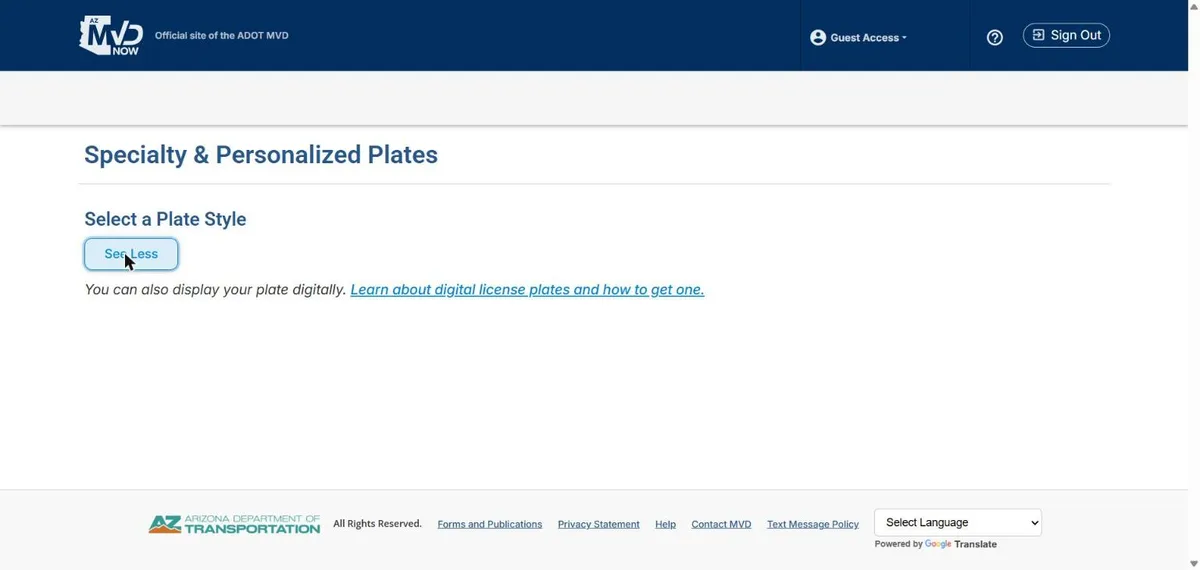
How does the plate check work on AZ MVD Now?
- Open azmvdnow.gov and sign in. If you don’t have an account yet, you can create one on the same page.
- Go to the plates page. The direct address is azmvdnow.gov/plates. It opens on “Specialty & Personalized Plates.”
- Select a plate style. Click “See All” to see every design, from the standard plate to more than 100 charity plates.
- Type your combination. Enter the letters, numbers and spaces you want. The site checks it against plates already issued.
- Read the result. If it’s open, you can keep going and order. If not, try a variation or a different plate style.
- Order and pay. You’ll pick the vehicle, explain what the plate means and pay the plate fee plus postage.
Button labels on AZ MVD Now change now and then. When I opened the plates page in October 2026 without signing in, the list of styles didn’t load at all. So sign in before you start.
No account, or the site is down? You can also order at an MVD office, at an Authorized Third Party office or by mail. Staff there can check availability for you.
Can you order at an MVD office or by mail?
If you’d rather not do it online, an MVD office or an Authorized Third Party office can check availability and place the order. Third Party offices are private businesses, so they can charge a convenience fee on top of MVD fees.
Whichever way you order, have this ready. Arizona’s personalized plate rule lists the details MVD needs on the application:
- the vehicle owner’s or lessee’s name and mailing address
- the vehicle’s make, year and VIN
- your current plate number and the date your registration expires
- the combination you want on the plate
- what the plate means, in plain words
Mail orders take the longest, because MVD only checks availability when your form arrives. If your first choice is gone by then, a backup saves you another round of mail.
What does “available” mean on the plate check?
An “available” result only means no one holds that exact combination on that style right now. It isn’t approval.
ADOT says all personalized plates are subject to review. A plate can pass the online check and still be turned down weeks later, after a person reads the meaning you gave it.
Taken plates don’t come back on a set schedule either. If someone lets their personalized plate lapse, it can open up again, but MVD doesn’t publish when. If you’re set on a combination that’s taken, run the check again every few months.
There’s one trick that works more often than people expect. The same letters can be free on one plate style and taken on another, because availability is checked per style.
What can you try when your first choice is taken?
Short, common words were claimed years ago. If your idea is one word under six letters, expect it to be gone on the standard plate.
Before you settle for something you don’t love, work through these in order. Run each one through the checker, since every variation counts as its own plate.
- Try the same letters on a different plate style. Availability is checked per design, so your word may still be open on a charity or university plate.
- Add or move a space, if the style allows one. “AZ HIKER” and “AZHIKER” can check as different combinations.
- Swap a letter for a number that looks like it, such as 0 for O or 8 for B. Just remember the review rules apply to whatever it spells.
- Add a short tag that means something to you, like your initials or the year you moved to Arizona.
- Drop vowels. People read “HKNG” as hiking faster than you’d think.
Whatever you land on, write down the meaning in plain words before you order. The application asks what the plate means, and a clear answer helps the review go smoothly.
How many characters can you use, and which words does MVD reject?
Arizona doesn’t use one fixed character limit. ADOT’s answer is that the maximum “varies” by plate style, so the tool limits what you can type based on the design you picked.
Some designs leave room for fewer characters than others. If your word is one letter too long on a specialty plate, try it on the standard Arizona plate before you give up on it.
The rules on content are in the Arizona Administrative Code, section R17-4-310. MVD rejects a combination if it:
- refers to sexual body parts or sexual or bathroom functions
- refers to illegal drugs, intoxicants or being high
- shows contempt for, or claims superiority over, a group of people
- copies another registration number
- is profane or obscene
- gets to any of those meanings through numbers, sound-alikes, foreign words, or by reading upside down or backward
That last rule is the one that catches people. Because it covers sound-alikes and backward reading, a “clever” spelling of a banned word is treated the same as the word itself.
If MVD rejects your plate, it tells you by mail. You get 10 days from that notice to appeal by letter to the Special Plates Unit, Mail Drop 801Z, PO Box 2100, Phoenix, AZ 85001-2100.
MVD can also recall a plate it already issued. You then have 30 days to turn it in or appeal, and you get the personalized fee back or a different plate.
How much do personalized and specialty plates cost?
A standard Arizona plate costs nothing beyond your registration. Customizing it adds a yearly fee on top, and you pay it every time you renew, not just once.

| Plate type | Extra cost | Notes |
|---|---|---|
| Standard plate | $0 | Comes with your registration |
| Personalized standard plate | $25 a year | Your own letters and numbers |
| Specialty plate | $25 first year, then $25 a year | $17 of each purchase and renewal goes to the sponsoring charity |
| Personalized specialty plate | $50 a year | $25 specialty plus $25 personalized |
| Postage | Varies | Not included in plate fees |
So a personalized charity plate runs $50 a year on top of registration. Over a five-year registration, that’s $250 for the plate alone, which is worth knowing before you fall for a design.
Picking a specialty design? It helps to look at the yearly cost the way you’d look at a donation. Of the $25 specialty fee, $17 goes to the group on the plate each year, whether that’s a university, a team or a cause.
Most specialty plates can carry the disability symbol at no extra charge. One more catch: ADOT doesn’t allow refunds or changes once you order, so check your spelling twice.
How long does it take to get the plate?
Allow up to four weeks. Plates, tabs and documents arrive by mail in a plain envelope, and there’s no office pickup.
Keep driving on your current plate until the new one shows up. Then swap it and put the new tab on.
Can you look up who owns an Arizona license plate?
Not for personal curiosity. Arizona’s motor vehicle records law, A.R.S. 28-455, says MVD can’t release personal information from a vehicle record except for listed purposes.
It mirrors the federal Driver’s Privacy Protection Act (18 U.S.C. 2721-2725). A name, home address or phone number tied to a plate counts as personal information.
I’ll say it plainly: if a website promises the owner’s name for a few dollars with no questions asked, be skeptical. Either it’s pulling old data from somewhere else, or it’s handing out information it shouldn’t.
Who can get owner details?
The permitted uses listed on MVD’s request form match the statute. The ones regular people most often fall under are:
- an attorney or licensed private investigator working on a case
- an auto liability insurer handling a claim
- a business checking information a customer gave it, to stop fraud
- notices to owners of towed or impounded vehicles
- a self-storage lien, a bonded title or another use the law spells out
- you have the vehicle owner’s written consent, on notarized form 96-0463
Police, courts and government agencies have their own access and use a separate form. A private person with a grudge, a crush or a parking dispute doesn’t qualify.
A better plan for a parking or blocking dispute is to go through whoever controls the space. That’s your HOA, landlord or property manager on private land, and the city’s parking enforcement on public streets.
Write down the plate, take a dated photo and keep notes. Those are exactly what a towing company, an HOA or an officer will ask for first.
How do you request a vehicle record with form 46-4416?
The form is called the Motor Vehicle Record Request, number 46-4416. The current version is marked R09/25, meaning September 2025.
- Download the form from ADOT’s forms library at apps.azdot.gov.
- Pick “Vehicle record” and give one main search item, the Arizona plate number or the VIN.
- Tick your permitted use on page 2 and add the supporting details it asks for.
- Sign in front of a notary or an MVD agent. That’s required unless you file through AZ MVD Now.
- Send it with payment to Records Management Unit, Mail Drop 504M, Motor Vehicle Division, PO Box 2100, Phoenix, AZ 85001-2100, or take it to an office.
The fee lines on the form are a bit cramped. As I read them, an uncertified record costs $2 at drop-off and $3 by mail or in office, and a certified record is $5.
A vehicle history is $3 uncertified or $5 certified. The form also says fees apply “per record / document or no record(s) found,” so a search that comes up empty still costs money.
MVD can also mail a copy of your request to the person whose record you asked for. The statute allows it, so don’t count on staying anonymous.
What do free lookup sites show?
Sites like FaxVIN, EpicVIN and VinAudit come up a lot when people search for a free Arizona plate lookup. They’re not run by the state.
What they usually do is turn the plate into a VIN, then show the car’s year, make, model and trim. Some add title brands, odometer readings or accident records, often behind a paywall.
That’s useful if you’re buying a used car and the seller’s plate is all you have. It won’t give you the owner’s name and address, and it isn’t an official record.
For free stolen-car checks, use the VIN at the National Insurance Crime Bureau’s VINCheck page. If you’re buying a car, ask the seller for the VIN anyway, because it’s printed on the title.
How can you find your own plate number?
Away from the car and blanking on your plate? It’s printed on your registration card and on your last renewal notice.
It also shows up in your AZ MVD Now account under your vehicles. That’s the fastest place to look if your paperwork is in the glove box.
How do you check your Arizona plate or registration status?
Sign in to AZ MVD Now and open your vehicle. Your registration’s expiration date is listed there, so you can see at a glance whether the plate is current.

When is registration due, and what are the late fees?
Arizona registrations expire either on the 15th or on the last day of the month. Check your card, because people with two cars often have one of each.
MVD tries to remind you by mail or email about 45 days before the due date. You don’t need that notice to renew.
You can renew online at AZ MVD Now, by phone at 1-888-713-3031, in cash at CheckFreePay locations, at an MVD or Third Party office, or by mail. The mailing address is ADOT Motor Vehicle Division, PO Box 29008, Phoenix, AZ 85038.
Late renewal costs $8, plus $4 for each month overdue, up to $100. Online and phone renewals have to be done by the due date, and mail has to be postmarked by then.
You can renew early, too. If your car needs an emissions test, you can renew up to 90 days ahead. If it doesn’t, you can renew up to six months early.
Before renewing, check whether your car needs an emissions test. ADOT shows this in your AZ MVD Now account, and in practice it mostly applies to vehicles based in the Phoenix and Tucson areas.
Most vehicles can be registered for one, two or five years, depending on emissions rules. A longer term means fewer renewals to forget, which is the easiest way to avoid the $8 late fee.
How do you track a plate you ordered?
Ordered a personalized plate or a replacement and it hasn’t arrived? First count the days. ADOT says up to four weeks for personalized plates.
After that, log in to AZ MVD Now to confirm the order went through and that your mailing address is right. A wrong address is the usual reason a plate never shows up.
Still nothing after four weeks? Contact MVD through the “Contact MVD” page on azdot.gov. Have your plate number, the VIN and your order date ready.
Lost, stolen or damaged plate?
A replacement plate costs $5 plus postage and handling. You can order it on AZ MVD Now, at an MVD or Third Party office, or by mail on form 96-0143.
| What happened | What you get | First step |
|---|---|---|
| Plate is damaged, faded or hard to read | Same letters and numbers | Order the replacement |
| Plate is lost | New letters and numbers | Order the replacement |
| Plate is stolen | New letters and numbers | Report it to local police, then order |
Lost or stolen plates always get a new number, even personalized ones. ADOT does that for your safety, since someone could be driving around with your old plate.
Report a stolen plate to police before you do anything else. Save the report number in case a photo radar ticket or parking notice shows up later with your old plate on it.
The new plate arrives with an updated registration and tab. Paying by mail? Send a check or money order for $5 plus the postage amount listed on the form.
What happens to your plate when you sell your car?
In Arizona the plate belongs to the owner, not the car. ADOT tells sellers to take the plate off before the new owner drives away.

That rule protects you. If the buyer kept your plate and ran red-light cameras with it, the notices would come to your house.
When you sell, ADOT’s list has three steps:
- Transfer the title. Use eTitle Transfer on AZ MVD Now if you qualify, or sign the back of the paper title and give it to the buyer.
- Submit a Sold Notice. Do it as soon as you sell, trade, donate or end a lease. It’s your proof of the date the car left your hands.
- Ask about a registration credit or refund. You may get money back for the unused part of your registration.
The plate can then go on your next car, which is how people keep a personalized plate for years. If you won’t need it, check with MVD about returning or canceling it.
For 2011 and newer vehicles, the title transfer needs an odometer reading in most cases. Read the actual number off the dash, don’t guess.
What should you check on the plate when buying a used car in Arizona?
Because plates stay with the seller in Arizona, a used car you buy from a private seller usually comes with no plate at all. That’s normal, not a red flag.
If the seller’s plate is still on the car when you look at it, use it for a quick check. Compare the plate and VIN on their registration card with the VIN on the dashboard and the driver’s door.
The numbers should match exactly. If the seller can’t show a registration card or title in their own name, walk away, or at least slow down.
Run the VIN through NICB VINCheck to see if it’s been reported stolen. A paid history report from a third-party site can add title brands like salvage or flood, which is worth the money on a car over a few thousand dollars.
After you buy, you title and register the car in your name through AZ MVD Now or an office. You’ll either move your own plate onto it or get a new one with the registration.
Ask the seller to file their Sold Notice right away. It protects them, and it also stops their name from showing on tickets tied to your new car.
What do Arizona plates look like, and how should you display them?
The standard Arizona plate has a desert sunset scene, the word “Arizona” across the top and the slogan “Grand Canyon State” along the bottom. The design dates to 1996. The flat-printed version used today came in 2008.
Standard plates are 12 by 6 inches and made of aluminum. Plates issued from 2008 to 2020 used three letters and four numbers, like ABC1234. Newer plates mix letters and numbers in a different seven-character pattern.
Beyond the standard design, you can pick from more than 100 specialty plates for universities, sports teams, veterans and charities. Arizona also lists digital license plates as an option on AZ MVD Now.
Arizona has only required a rear plate since 1989, so most cars don’t need a front plate. ADOT’s display rules for that rear plate are simple:
- mount it on the back and fasten it securely
- keep it at least 12 inches off the ground
- keep it clean and easy to read
- don’t cover the word “Arizona” with a frame
That last one trips up plenty of drivers. A thick dealer frame that hides “Arizona” or your tab is an easy reason for a traffic stop.
Can a plate number help with a hit-and-run, parking or ticket problem?
Got hit and only have the other driver’s plate number? Call the police and file a report with the plate, the car’s color, make and model, and the time and place.
Police can run the plate. You can’t, but your insurer can request the record because insurance claims are a permitted use.
For a car abandoned on your property, ADOT has an Abandoned Vehicle Unit and a separate abandoned vehicle report process. Use that, not a plate search.
Searching for tickets by plate number is harder. As far as I can tell, Arizona has no statewide court search that takes a plate number. Photo enforcement and parking tickets are handled by the city or court that issued them.
If you think you have a ticket, call the court listed on the notice or check that city’s online payment page. Most of those ask for the citation number.
Common questions
Yes. Checking a combination on AZ MVD Now costs nothing. You only pay the $25 personalized fee, any specialty fee and postage when you actually order.
We couldn’t find any reservation or hold option on ADOT’s pages. A combination is yours once you order it and MVD approves it, so order quickly once you find one that’s open.
Yes. Arizona’s rule lets someone else apply for the plate as a gift. The application still needs the owner’s vehicle details, and the gift giver adds their own name and address.
No. ADOT says no refunds or changes are allowed once you order. The exception is when MVD itself recalls the plate, and then it refunds the personalized fee.
Yes, if you’re a current Arizona resident. ADOT’s record request form says current residents can get their own motor vehicle records online at AZMVDNow.gov. Requests filed there skip the notary step.
No, not for a regular passenger car. Arizona has required only a rear plate since 1989, and ADOT’s display rules refer to the rear of the vehicle.
You get a new plate with different characters, just like a standard plate. ADOT doesn’t reissue the same combination after a loss or theft.
Sources used for this Arizona plate guide
- ADOT MVD: License Plates and Disability Placards
- AZ MVD Now: Specialty & Personalized Plates
- Ariz. Admin. Code R17-4-310, Personalized License Plates
- A.R.S. 28-455, Release of personal information
- ADOT form 46-4416, Motor Vehicle Record Request
- ADOT MVD: Vehicle Registration
- ADOT FAQ: Replacement license plate and fee
- ADOT MVD: Selling Your Vehicle
Last reviewed October 27, 2026. Fees and rules can change, so check ADOT before you pay.
Planning a trip or a move? We also cover California license plates, Colorado plates and Alabama plate options.